Hello, it’s Tom!
Today I’m sharing a two‑day, one‑night itinerary around Toyama. Thanks to the Hokuriku Shinkansen, Toyama feels wonderfully close—and it packs the bounty of the sea, the elegance of wood-and-glass architecture, and the legacy of traveling medicine merchants into a compact, walkable city. The moment I stepped off the train, the air felt a shade clearer—maybe the winter chill helped, too.
Even in just 48 hours, you can savor the coast, the townscape, and the history without feeling rushed. Distances are short, margins of free time are generous. The flavors are rich; the afterglow is long.
On this trip I started with the gentle sweetness of Toyama Bay sushi, rode the streetcar to the port town of Iwase, touched the layered history at the castle site, paired local sake with seafood after dark, then dove into Toyama’s “city of medicine” heritage and the light-filled world of the glass art museum. I wrapped it all up with a Masu‑sushi box for the ride home.
- Table of Contents
- Day 1 — Learning the Beauty of “No Soy Sauce” with Toyama Bay Sushi
- Streetcar North: Twenty Minutes to the Old Port Town of Iwase
- Touching the Memory of Old Toyama Castle — A Castle Town with Grit
- Evening at Gin Chirori — Hane‑ya Sake and Seafood, a Quiet Lift
- Nightcap at Ramen Iroha (CIC B1) — A Black & White Taste Test
- Day 2 — Back to the Roots of a Medicine Town: Ikedaya Yasube
- A Forest of Wood and Glass — Toyama Glass Art Museum
- Before the Train — Masu‑sushi from Kawakami to Take Today Home
- Mini Guide
- Conclusion — A City that Fills You with Care, Not Flash
Table of Contents
- Day 1: Toyama Bay sushi / Streetcar to Iwase / History at the castle site / Night at Gin Chirori + local ramen
- Day 2: Origins of Toyama’s medicine culture at Ikedaya Yasube / Toyama Glass Art Museum / Masu‑sushi for the journey home
- Notes from the Road: A gentle counterpoint to common travel advice
- Mini Guide: Getting around, time budget, and reservation tips
Day 1 — Learning the Beauty of “No Soy Sauce” with Toyama Bay Sushi
Around noon I arrived at Toyama Station. As I slipped through the ticket gates the air turned crisp, and I felt that little click: vacation mode, engaged. Ignoring the regional fair happening in the concourse (tempting!), I headed straight for Aburi‑an Toyama‑zushi.
I didn’t hesitate: the Toyama Bay 10‑piece set. Toyama Bay is called a “natural fish tank,” a coastline blessed with a surprising variety of species. Here, each piece comes seasoned to showcase the fish at its best, so you don’t really need soy sauce. One bite and I thought, “This needs no explanation.” The sweetness of the fish lands softly on your tongue and melts away.
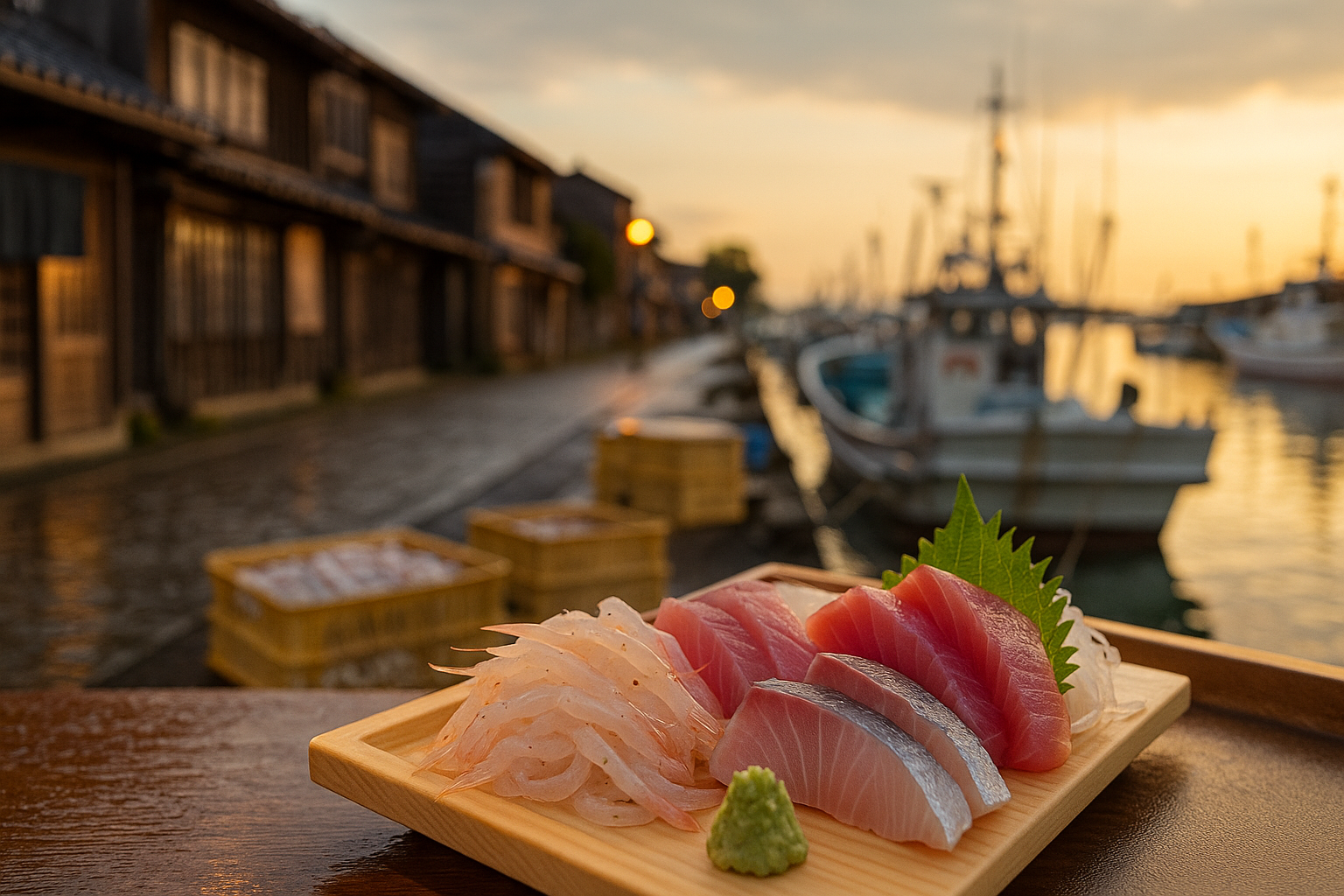
Shiro‑ebi—Toyama’s translucent white shrimp—steals the show. Every time the delicate flesh loosens on your tongue, a gentle ocean aroma spreads. The strength of Toyama sushi is that it wins with the natural sweetness of the catch, not with soy sauce. On days when I might dunk everything, my hand just… stops. Then the anticipation for the next piece revs up.
Travel Note: The exact 10 pieces vary with the season and the day’s catch. The number is constant; the lineup is not—each set is a small once‑in‑a‑lifetime.
Streetcar North: Twenty Minutes to the Old Port Town of Iwase
After lunch I hopped on the Toyama Chihō Railway streetcar heading north. Sunlight flickered on the river as the city’s tempo gradually slowed. About twenty minutes later I arrived at Higashi‑Iwase, the gateway to the port town.
My recommended route: get off at Higashi‑Iwase, walk through the historic streets, and exit via Iwasehama Station. White‑walled storehouses, lattice‑front townhouses, sake brewery signboards, and thin alleyways catching stripes of light. The hush seems to absorb your footsteps; it’s a different rhythm from your usual tourist bustle—a streetscape where everyday life still lingers.
The historic Mori residence was closed that day, but I toured the Baba residence instead. The way the wind moves from earthen floor to tatami rooms, the home’s plan that integrates business and living—all reveal a port town’s practical grace. The paper‑screened light is the sort that photographs struggle to capture but memory holds.
Keep walking and the path opens to the Sea of Japan at Iwasehama. Toyama’s blue isn’t showy; it’s a patient palette of shades that slowly fills your field of view. On hazy days the horizon blurs, and the line between sea and sky gets shy. Take one deep breath here. The salt air reaches all the way inside your chest.
Travel Note: Higashi‑Iwase → Iwasehama takes about an hour at an unhurried pace. There are cafés and a sake brewery along the way if you want a break.
Touching the Memory of Old Toyama Castle — A Castle Town with Grit
Back in the city center I headed to Toyama Castle (Toyama City Museum of Local History). The reflection of stone walls in the water is beautiful—no wonder the castle’s nickname is “Uki‑jō,” the Floating Castle.
Step through the gate and the air cools; it feels like walking into a different layer of time. Exhibitions focus less on flashy battle tales and more on steady industrial promotion and scholarship, the quiet engines that drove Toyama’s growth even while neighboring domains loomed large. That, in a word, is Toyama’s character.
The present “castle‑style” building was reconstructed in 1954 as a post‑war symbol of recovery, originally built as a pavilion for an industrial exposition before reopening as the local history museum. Models and videos help you scan Toyama’s path from the Warring States to modern times, and the layout of the old castle town begins to click into place.
From the top floor you can look down on the moat and the city, and you realize the current park is only a sliver of what once stood here.
Evening at Gin Chirori — Hane‑ya Sake and Seafood, a Quiet Lift
As dusk fell I made for Gin Chirori, a sister restaurant to the wildly popular Gingyo. The room was already packed. The entrance is a little tucked away, so it’s wise to check the route in advance. Reservations are essential.
First pour: Hane‑ya, a local sake with a floral nose and a silky glide. The assorted sashimi glistened with a transparent sheen; each cut seemed to shift the ocean’s temperature by a degree. Yellowtail with ponzu layered sweet fat with citrus, the crab cream croquette hid a slow, warm sweetness inside, and the seafood spring roll snapped cleanly before releasing a whisper of tide.
Despite the popularity there’s no frantic pace—service has a calm, careful rhythm. Even at full capacity, dinner never feels rushed. Good restaurants don’t just season the food; they season time. A local uncle at the next seat struck up a lighthearted chat over his beer—one more small memory to take home.
Travel Note: When booking, ask about counter vs. table. The counter has great kitchen theater and makes conversation easy.
Nightcap at Ramen Iroha (CIC B1) — A Black & White Taste Test
To close the night I went to Ramen Iroha in the basement of the CIC shopping complex. I ordered the half‑and‑half set: Toyama Black and Shiro‑ebi Salt—the city’s twin emblems in a single tray.
Toyama Black looks intense but isn’t just a salt bomb; the soy sauce has depth, sharpened by black pepper—a gentle wake‑up call for the nighttime wanderer. The Shiro‑ebi salt leans into sweetness and minerals, dissolving easily into the body. Black to brighten, white to soothe; together they read like a two‑chapter story.
Travel Note: Even the half set satisfies. A slightly later visit helps you dodge peak queues.
Day 2 — Back to the Roots of a Medicine Town: Ikedaya Yasube
Morning of day two: time for Toyama’s other face—medicine. I headed to Ikedaya Yasube. The Edo‑era storefront naturally straightens your posture. Toyama’s traditional oki‑gusuri system—placing a medicine box in a home and paying later for what you used—spread nationwide. A business model built on trust is a point of local pride.
Inside you can try a yagen (traditional mortar) and grind medicinal herbs yourself. The steady, gritty vibration through your hands feels like a tactile bridge to everyday life in another age. It’s not flashy, but it resonates. “Medicine” can sound clinical; here it feels like human‑scale ingenuity.
Travel Note: The hands‑on activity takes around 20 minutes. Go at opening time to avoid waiting.
A Forest of Wood and Glass — Toyama Glass Art Museum
Next I walked to the Toyama Glass Art Museum, twinned with a public library. From façade to interior, the marriage of wood and glass is almost temple‑like in its serenity. Light pours from above and softens across timber beams, setting a quiet temperature throughout the building. The architecture itself is already an exhibit.
In the galleries, transparent glass holds light inside and blurs the edges of form. Polished lines wake up your fingertips by sight alone, and you start to grasp glass as a material of possibility. Sometimes art reaches the body before it reaches words; this is one of those places.
The cohabitation with a library is another charm. Locals borrow books as usual while travelers like me gaze at art next door. Tourism and everyday life breathe easily in the same space. It’s quiet. It’s rich.
Travel Note: Start at the 6th floor and work your way down. Check the official site for exhibition changeovers.
Before the Train — Masu‑sushi from Kawakami to Take Today Home
For my last stop I chose Toyama’s iconic Masu‑sushi. I headed to Kawakami. Honestly, I could say I came to Toyama for this. Opening the box always brings a fresh rush of anticipation.
The gentle sweetness of the vinegared rice balances perfectly with the umami of the trout. It has the pleasant density of a pressed sushi without feeling heavy. It’s wonderful on the spot, but nibbling it slowly on the ride home is a delight, too. Every time you close the lid, it feels like you’re tucking away another slice of the day’s scenery.
Travel Note: Time your purchase to match your travel schedule for the best texture. The staff explain storage and slicing with care.
Mini Guide
Time Budget
- Day 1 Noon: Arrive at Toyama Station → Lunch (1 hr) → Streetcar to Iwase (20 min) → Town walk & visit (2–3 hrs) → Back to city & castle site (1 hr) → Dinner (2 hrs) → Ramen nightcap (30 min)
- Day 2 Morning: Ikedaya Yasube (1 hr) → Late morning–afternoon: Toyama Glass Art Museum (1–1.5 hrs) → Souvenir shopping (30 min)
Reservations & Access
- Gin Chirori is very popular—reserve. The entrance is tucked away; double‑check maps beforehand.
- The Glass Art Museum has periodic rotation; check hours and exhibition schedules.
Walking Comfort
- Iwase’s stone paths are mostly flat, but photos slow you down. Sneakers are your friend.
Small Eating Tips
- With Toyama Bay sushi, start as is—no soy sauce—to notice the natural sweetness.
- Toyama Black can make you thirsty; hydrate a bit extra afterward.
Conclusion — A City that Fills You with Care, Not Flash
Toyama’s seafood, history, and crafted work sit side by side without shouting. Each seems modest—until you lean in. Quieter towns reward each step with a small discovery. This two‑day visit reminded me of that.
The sweetness of white shrimp, the pace of a streetcar, the scent of grass by the castle moat, the lingering note of Hane‑ya, the cool light of glass, the papery feel of a Masu‑sushi wrapper—none of it is loud, yet together they gather in your chest. By the time the trip ends, a soft light is glowing inside.
“Let’s come back.” When places like that multiply in your life, even everyday scenery looks a little kinder. Toyama is one of those places.
See you on the next trip!
Appendix: Places Visited
- Aburi‑an Toyama‑zushi (Toyama Bay 10‑piece set; enjoy the sweetness without soy sauce)
- Higashi‑Iwase → Iwasehama (white‑walled townscape; toured the Baba residence; the Mori residence was closed that day)
- Toyama Castle / Toyama City Museum of Local History (learn the city’s development; “Floating Castle” view)
- Gin Chirori (Hane‑ya sake; assorted sashimi; yellowtail with ponzu; crab cream croquette; seafood spring roll)
- Ramen Iroha (CIC B1) (Black = Toyama Black; White = Shiro‑ebi Salt; half‑and‑half set)
- Ikedaya Yasube (hands‑on yagen grinding; dive into Toyama’s medicine heritage)
- Toyama Glass Art Museum (with public library; wood-and-glass architecture)
- Kawakami Masu‑sushi (take the day’s afterglow home)