Hello, I’m Tom.
This time, I took a two-day, one-night trip starting from Okayama and making my way to Kochi.
The journey began with a simple craving: “I want to eat authentic salt-seared bonito.” Before I knew it, I was boarding the Limited Express Nanpū at Okayama Station, heading across Shikoku to Kochi.
As the relaxing train ride continued, I was captivated by the breathtaking view of the Oboke and Koboke gorges along the way. It felt like a switch had been flipped, and the spirit of travel took over. Here’s a record of that memorable trip to Kochi.
- Gazing at Gorges from the Train Window
- Greeted by Historic Heroes at Kochi Station
- Lunch Plans Shift from Hirome Market to the Shopping Arcade
- The Savor of Seared Bonito at Myojinmaru
- Kochi Castle and the Blacksmiths of the Castle Town
- Dinner Across Three Local Favorites
- Sunday Morning Market and Katsurahama Beach
- Wrapping Up the Journey
Gazing at Gorges from the Train Window
The trip from Okayama to Kochi takes about two and a half hours on the Limited Express Nanpū.
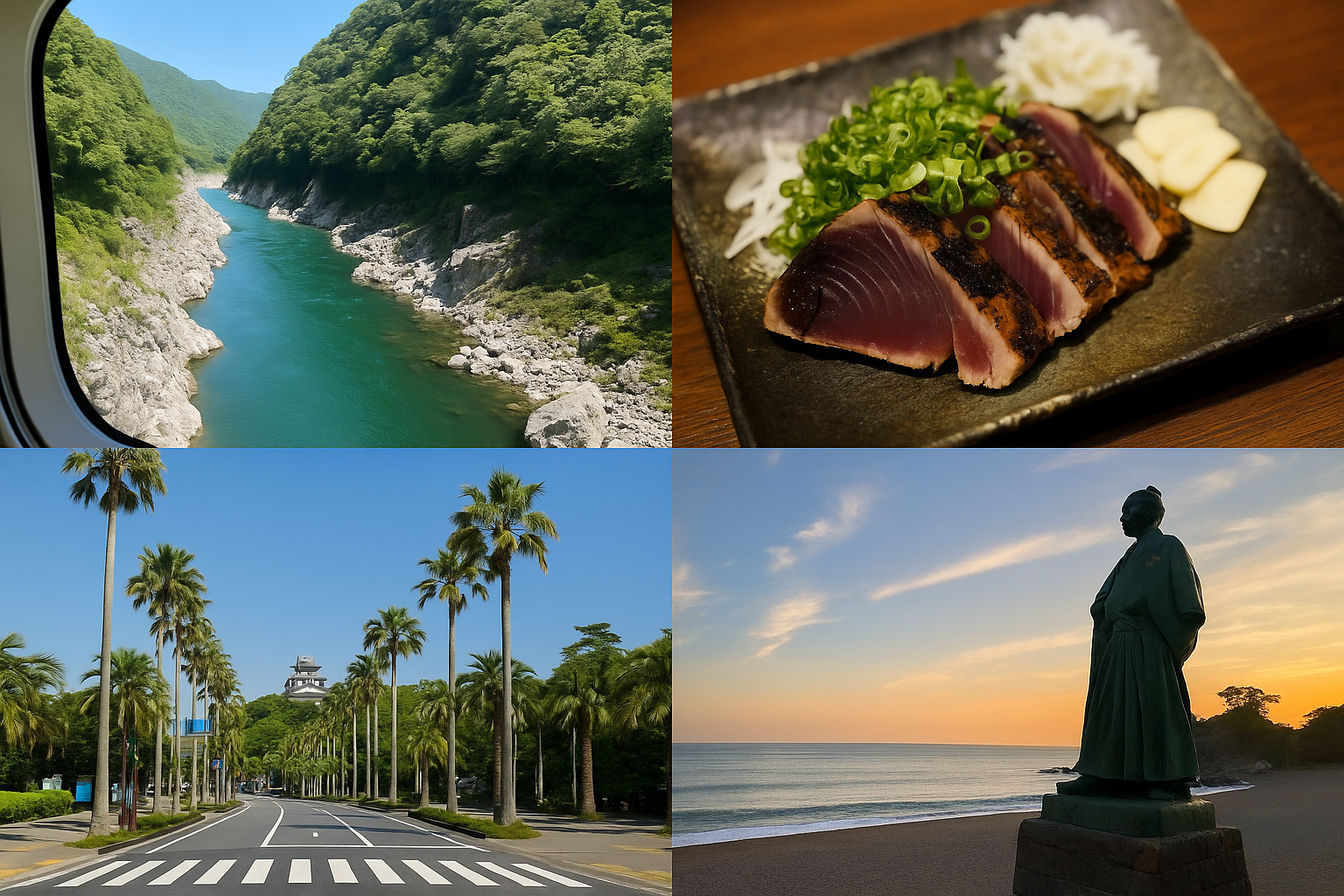
As the train passed through the Oboke and Koboke area in Tokushima Prefecture, emerald-green rivers and steep, dramatic gorges came into view outside the window.
The train slowed down slightly along the cliffs, giving passengers time to take in the roaring rapids and towering rock faces. Cameras clicked throughout the car.
These gorges were carved over millions of years by the Yoshino River cutting through the Shikoku Mountains—a true geological masterpiece.
It almost felt like the train was slowing down just to showcase this natural highlight.
Greeted by Historic Heroes at Kochi Station
Arriving at Kochi Station, I was immediately welcomed by giant bronze statues of legendary samurai from the end of the Edo period.
Sakamoto Ryoma, Nakaoka Shintaro, and Takechi Hanpeita stand tall in front of the station, watching over travelers with pride.
Kochi is a place steeped in the dramatic events of the late Edo era. Just passing through the ticket gate filled me with a sense of historic gravity.
Inside the station, there was also an Anpanman train display. Kochi’s Kahoku Town is the birthplace of Takashi Yanase, the creator of Anpanman.
Brightly colored and full of whimsy, the Anpanman train brought an instant burst of joy to the start of the trip.
Walking outside the station, I noticed palm trees lining the street, adding a tropical vibe.
These palms were planted by the city of Kochi starting in the 1950s as part of an urban beautification project. Their warm, subtropical feel matches Kochi’s climate and adds a southern charm.
They’ve become a defining symbol of the city—unexpected for Shikoku, but absolutely fitting for Kochi.
Lunch Plans Shift from Hirome Market to the Shopping Arcade
For lunch, I headed to Kochi’s culinary haven: Hirome Market.
This lively indoor market is where locals and visitors gather to enjoy all kinds of food at communal tables. But the crowd was intense—getting a seat was nearly impossible.
So I changed plans and walked to the nearby Obiyamachi shopping arcade.
That’s where I found the famous restaurant Myojinmaru, known for its seared bonito.
The Savor of Seared Bonito at Myojinmaru
I ordered a combo of salt-seared and sauce-seared bonito.
Kochi’s specialty, bonito tataki, is prepared right in front of you by searing the fish over burning straw. The flames flare high, and the crackling sound is matched by the rich aroma of the straw smoke.
The salt-seared version highlights the natural flavor of the fish, with the straw adding a subtle smokiness. The sauce version, paired with garlic and garnishes, is incredibly satisfying over rice.
I also tried the local treat “Imoten”—deep-fried sweet potato. Crispy on the outside, fluffy inside, and with just a touch of salt.
Myojinmaru has locations across Japan, but there’s something special about tasting it at the original store. It’s where flavor meets memory.
Kochi Castle and the Blacksmiths of the Castle Town
After lunch, I made my way to Kochi Castle.
Built in 1601 by Yamauchi Kazutoyo, the first lord of the Tosa domain, Kochi Castle is one of just 12 castles in Japan with an original keep (tenshu).
Even more rare, it still retains its original honmaru palace alongside the keep, making it a nationally significant historical site.
Climbing the stone steps, the keep gradually appears through the trees—a stunning structure with elegant curves and solid foundations.
From the top, the view stretches across Kochi City, and on a clear day, all the way to the Pacific Ocean.
Inside the castle, you’ll find exhibits recreating Edo-period life, including replicas of armor and swords—pure delight for history buffs.
On the way back down, I noticed several blacksmith shops lining the castle town streets, offering blades and tools—a reminder of the region’s samurai heritage.
Dinner Across Three Local Favorites
The first dinner stop was Kokko-tei.
There, I enjoyed yakitori made from two local chicken breeds: Tosa Jiro and Tosa Hachikin.
Tosa Jiro is famous for its eggs, but its meat is also known for being firm and flavorful. Grilled over charcoal, the crispy skin and juicy inside made each bite a delight.
Washed down with a cold beer, it was a perfect start to the evening.
Next, I wandered into Sakaguni Chosokabe.
The name caught my eye, as I had just visited Kochi Castle and was thinking about Chosokabe Motochika, a historic lord of the region.
I ordered classic Kochi appetizers: dorome (raw whitebait), deep-fried moray eel, and chikuwa with cucumber (chikukyu).
The dorome was smooth and slightly briny—paired beautifully with a chilled glass of Tosa Tsuru sake.
Finally, I lined up at the famous street-side gyoza stand, Yatai Yasubee.
Rumored to always have long queues, I arrived just before the rush. Standing at the counter, I devoured crispy dumplings with an ice-cold beer—a true taste of Kochi nightlife.
Sunday Morning Market and Katsurahama Beach
The next morning was Sunday, perfect for exploring the weekly Sunday Market, a tradition in Kochi for over 300 years.
The streets were lined with fresh produce, pickled goods, dried fish, and handmade crafts. Just strolling and chatting with friendly vendors was an experience in itself.
Later, I hopped on a bus to Katsurahama Beach.
The sun was shining, the waves were sparkling, and the breeze carried the scent of the sea. It was a serene and refreshing start to the day.
This scenic spot is famous for its large statue of Sakamoto Ryoma, a national hero.
Nearby is the Kochi Prefectural Sakamoto Ryoma Memorial Museum. It features artifacts from Ryoma’s life—letters, personal belongings, and historical timelines.
One letter especially stood out: it was incredibly long, written with care and full of furigana (reading aids), showing Ryoma’s thoughtfulness toward his readers.
His famous quote, “Let us once again cleanse Japan,” still resonates as a call for renewal and courage.
Wrapping Up the Journey
And just like that, my Kochi trip came to an end.
The gorge views from the train. The aroma of seared bonito. The sweet crunch of imoten. The nostalgic street stalls and the calm of the Pacific waves.
Each memory touched a different sense, and all of them stayed with me.
On the train ride home, I smiled quietly to myself, thinking:
“I want to come back.”
That’s what Kochi does to you.
Until next time!