Hello! I’m Tom.
Today, I want to share with you my travel journal from a 2-day, 1-night trip through Kagawa Prefecture.
Kagawa is often nicknamed “The Udon Prefecture,” and while that may sound like a punchline, it’s not far from the truth. But here’s the thing—Kagawa is about more than just noodles. With its rich history, serene nature, and unique food culture, the region offers a travel experience that feels quietly profound.
My trip started off with some travel delays and a hungry stomach, but from the moment I arrived in Takamatsu, I was met with a string of surprises and moments of calm. It’s the kind of place that doesn’t shout its charm but whispers it gently, and if you’re listening, you’ll be rewarded.
So here’s my full travel story—no edits, no skipping.
- Day 1 – Arriving in Takamatsu: A Bumpy Start, a Soft Landing
- Lunch = Udon, of Course! “Sanuki Men no Suke” to the Rescue
- A Stroll Through History at Tamamo Park (Takamatsu Castle Ruins)
- Nature on a Grand Scale: Ritsurin Garden
- Dinner = Bone-in Chicken Bliss: Honetsukidori
- Day 2 – Morning Udon and Local Life at Merikenya
- Grand Finale: The Panoramic Majesty of Yashima
- Wrapping Up: What Kagawa Left Me With
- Souvenirs & Useful Links
Day 1 – Arriving in Takamatsu: A Bumpy Start, a Soft Landing
It was early afternoon when I finally arrived at Takamatsu Station. Originally, I had planned to arrive in the morning and take my time exploring. But thanks to a delayed flight, I spent a good part of the day waiting around and landed much later than expected.
I was exhausted. The kind of tired that settles in your shoulders and doesn’t let go. But stepping out of the station, I was hit by a salty sea breeze and the wide, open sky of Takamatsu. It felt like a soft reset.
Lunch = Udon, of Course! “Sanuki Men no Suke” to the Rescue
You can’t set foot in Kagawa without eating udon. And for my first bowl, I headed to “Sanuki Men no Suke,” a casual but highly rated udon shop within walking distance of the station. One practical note—many udon places in Takamatsu are closed on Sundays, but this one is open. A small detail that becomes a big deal when you’re hungry on a weekend trip.
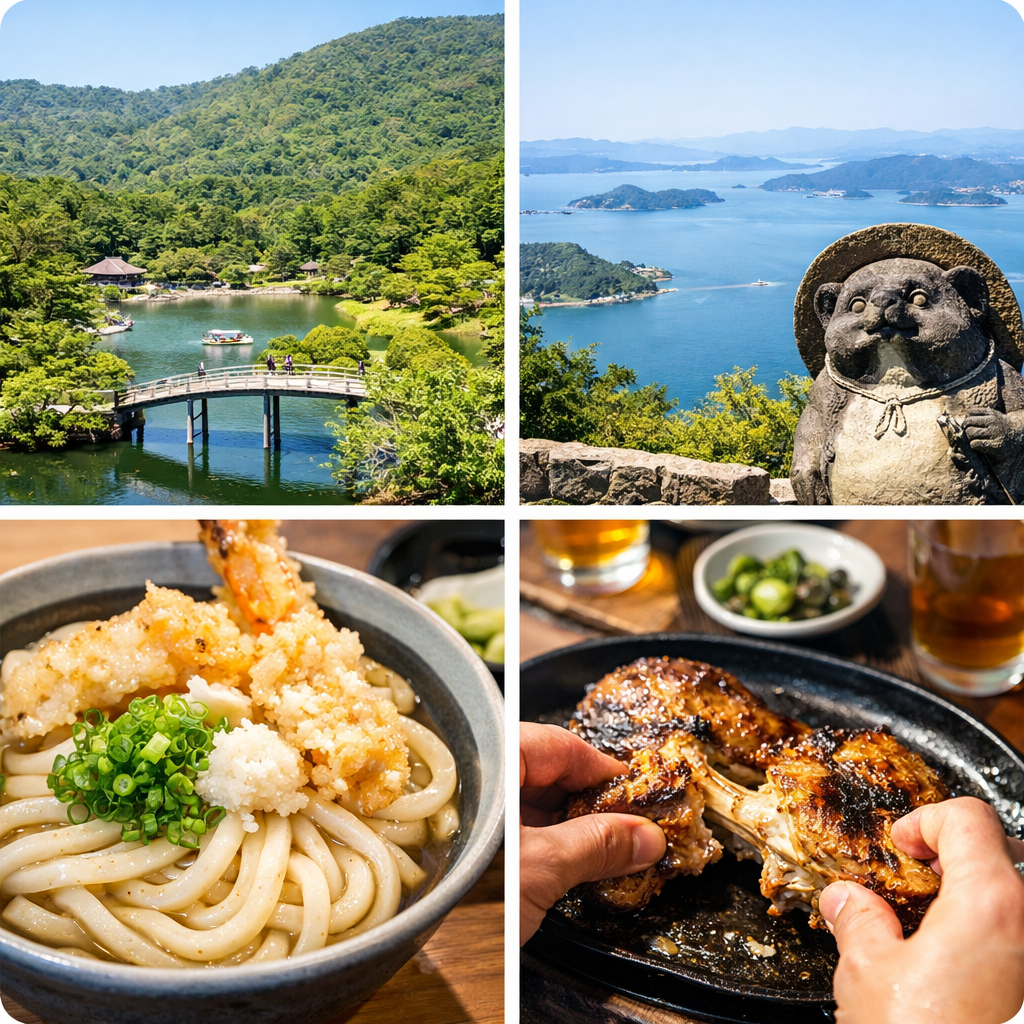
The udon? Thick. No, thick. The kind that looks like it could double as rope. But once you bite in—wow. The noodles are perfectly chewy, almost bouncy, and they carry the subtle sweetness of wheat. The broth was light but packed with umami, and everything just slid down with that silky slurp that only proper udon has.
With every bite, I felt the fatigue drain away.
A Stroll Through History at Tamamo Park (Takamatsu Castle Ruins)
With my belly full, I headed to Tamamo Park, home to the remains of Takamatsu Castle. What makes this castle unique? It’s one of Japan’s rare “water castles,” where seawater is actually drawn into the moats. That’s right—this place literally floats in history.
Originally built by feudal lord Ikoma Chikamasa, the castle is one of the “Three Great Water Castles” in Japan. Today, sea bream still swim in the moat’s saltwater. I bought a little bag of fish food (100 yen) and sprinkled some from the bridge. In seconds, dozens of sea bream appeared with a splash, as if to say, “Welcome to Takamatsu!”
Walking further into the park, I passed by impressive stone walls and carefully reconstructed turrets. The wind stirred the pine trees, and sunlight filtered gently through their branches. Each step along the shaded paths felt like I was drifting through a peaceful pocket of time.
By the way, the name “Tamamo” comes from the Man’yōshū—the oldest collection of Japanese poetry—and refers to a type of seaweed. It’s a name with deep roots in the sea, much like the castle itself.
Nature on a Grand Scale: Ritsurin Garden
Next stop: Ritsurin Garden. This is no ordinary garden—it’s a nationally designated Special Place of Scenic Beauty and a recipient of three stars in the Michelin Green Guide.
How big is it? Think three Tokyo Domes. Massive.
As soon as I stepped inside, the urban world melted away. Pine trees trimmed like bonsai but as tall as buildings, tranquil ponds mirroring the sky, bridges arching in just the right places, and distant hills adding layered depth. It’s the kind of place that’s been so carefully designed that it feels natural.
You can take a traditional boat ride through the central pond, but I explored on foot this time. Even without the boat, the sights were overwhelming in the best way. From the viewpoint at Hiraiho, you can look out across the entire garden. It’s one of those views that photos just can’t capture.
Dinner = Bone-in Chicken Bliss: Honetsukidori
As the sky turned orange and the city lights flickered on, I checked into my hotel and set off in search of dinner. The choice? Kagawa’s soul food—Honetsukidori (bone-in chicken).
Originally from Marugame City, this dish has become popular throughout the region. The menu usually gives you two choices: “Oya” (older chicken) or “Hina” (young chicken). Oya is tough and packed with flavor—a chewy bite for those who like to savor. Hina, on the other hand, is tender and juicy, with crispy skin and a succulent center. A safer choice for newcomers.
I ordered the Hina. It arrived sizzling on a hot plate, glistening with oil and spices. I grabbed it with my hands (as tradition demands), took a bite, and was instantly sold. Crispy outside, juicy inside, and just enough spice to demand a cold beer.
At the table next to me, a guy muttered, “After this, no Tokyo fried chicken will ever be good enough.” I silently nodded in agreement.
Day 2 – Morning Udon and Local Life at Merikenya
Day two started—how else?—with another bowl of udon.
This time I went to “Merikenya,” right outside Takamatsu Station. It opens at 7 a.m., and as I walked in, I saw locals—construction workers, office employees, retirees—all lining up without hesitation. It was clear that for many, this was a daily ritual.
I got a warm kake-udon, simple and elegant. The dashi broth was delicate, and it gently woke up my senses. A humble but perfect way to begin the day.
Grand Finale: The Panoramic Majesty of Yashima
For the final stop of the trip, I took a bus out to Yashima, a mountain-like plateau that juts into the sea east of Takamatsu. The name literally means “roof island”—and once you see its shape, you’ll understand why.
As the bus climbed the winding road, the view behind me opened up dramatically. And then, at the observatory, I was greeted by a vista that actually made me stop and stare.
Dozens of islands scattered across the Seto Inland Sea, the faint outline of Honshu on the horizon, and sunlight glittering on the water like scattered jewels. Birds chirped, trees swayed, and for a moment, the world stood still.
Nearby sits Yashima-ji Temple, number 84 on the Shikoku Pilgrimage. The red buildings, stone statues, and forested paths are steeped in a quiet, spiritual atmosphere. Pilgrims dressed in white quietly made their way through the grounds. It was beautiful.
Yashima is also the site of the famous Battle of Yashima from the Genpei War. Here, Minamoto no Yoshitsune carried out a daring surprise attack. One legend in particular stands out—Nasu no Yoichi shooting a fan placed atop a Heike ship. That very scene is commemorated with statues and plaques.
Walking through the area, you’ll come across signs, poems, and markers that tie the mountain to that dramatic history. But Yashima also has a playful side.
Right next to the observatory is a tiny “tanuki (raccoon dog) park,” celebrating the folklore of shapeshifting tanuki said to inhabit the area. It even appeared in the Ghibli film Pom Poko. Their comical expressions made me laugh out loud, cutting the solemnity of the moment just a little.
Before heading down, I bought a pack of Kawara Senbei—roof tile-shaped crackers, crispy and subtly sweet. I held one in my hand, looked out over the plateau, and thought: I’ll be back.
Wrapping Up: What Kagawa Left Me With
As I descended Yashima and rode the bus back toward the station, I scrolled through the photos I had taken. There were bowls of udon, pine trees, sea bream, temple roofs, and tanuki statues.
It felt like I’d seen and tasted so much, and yet, everything was held together by a quiet, gentle thread.
Kagawa isn’t flashy. It doesn’t overwhelm. It’s comforting.
If you ever find yourself thinking, “I need a break, but I don’t want to plan something complicated,” this might be your answer.
Kagawa heals. Kagawa smiles. Kagawa feeds you well.
See you again, someday.
Souvenirs & Useful Links
Top Souvenir Picks:
- Kawara Senbei (Yashima specialty): Crunchy, tile-shaped crackers with a nostalgic sweetness
- Take-home Honetsukidori: Some shops offer vacuum-packed versions—perfect for your home kitchen
- Olive Oil & Skincare Products: From Shodoshima Island, known for its olive production
- Dried Sanuki Udon Noodles: Bring Kagawa’s iconic chewiness home with you
Official Links: