Hello! It’s Tom here.
Today, I’d like to share a recent trip I took to Tokushima.
To be honest, Tokushima might not have the flashy “major tourist destination” vibe compared to other places in Japan.
But once I visited, I realized something.
It’s quiet, layered, and filled with a subtle kind of charm.
Not loud, but deeply memorable.
Let me walk you through my three days there.
Day 1 — Finally Feeling “Arrived” with Tokushima Ramen
The trip didn’t exactly start smoothly. My flight from Haneda was delayed, and by the time I arrived at Tokushima Airport, it was already night.
Originally, I had planned to head to the foot of Mount Bizan and maybe enjoy the night view…
But that plan disappeared quickly.
At that point, I just wanted food and sleep.
While wandering around Tokushima Station, I found a ramen shop called “Menpachi,” serving Tokushima ramen—a local staple you don’t often see in other regions.
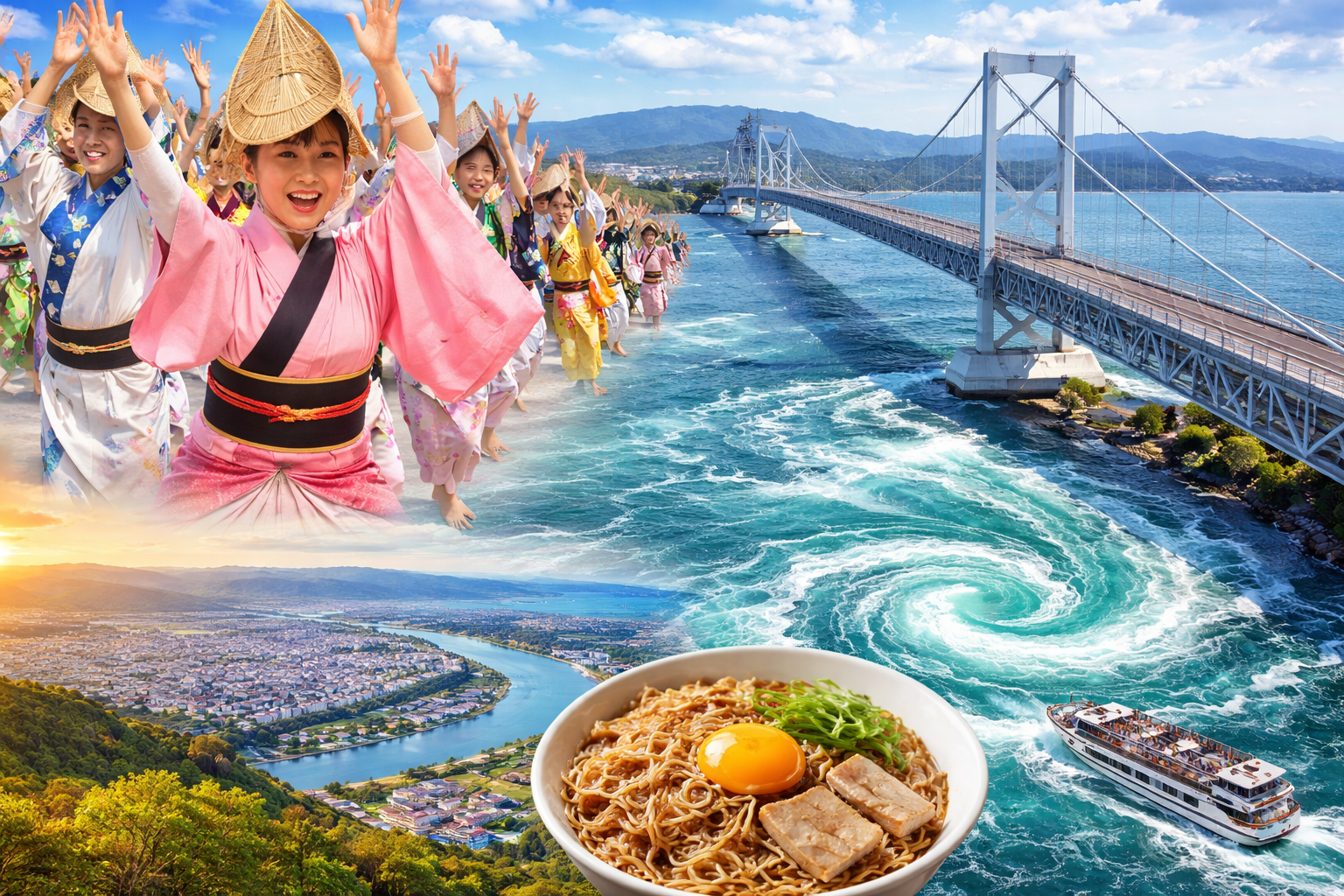
Tokushima ramen features a rich pork-bone soy sauce broth with a raw egg dropped right on top.
I ordered a bowl loaded with sliced pork belly.
The flavor was bold and savory, and I learned that locals often eat it with a bowl of white rice.
When I cracked the egg into the soup, it added a smooth richness that made the whole dish incredibly addictive.
With each bite, the fatigue from travel slowly melted away.
Day 2 (Morning) — An Unexpected Encounter with Literature on Mount Bizan
The next morning, I headed to Mount Bizan, a symbol of Tokushima City.
Since I planned to take the ropeway, I expected a simple sightseeing experience.
But I ended up with something more.
There was a 15-minute wait before departure, so I wandered into a small exhibition space inside the Awa Odori Kaikan—called the Moraes Museum.
José de Moraes, a former Portuguese naval officer, spent his later years in Tokushima, deeply immersed in Japanese culture.
His story—his quiet life, his love, his letters—had a gentle, literary atmosphere.
What I thought would be a quick stop turned into over 10 minutes of quiet reflection.
Moments like this make travel feel unexpectedly rich.
After that, I boarded the ropeway. The ride takes about five minutes.
As we climbed, views of the Yoshino River and the Pacific Ocean gradually opened up outside the window.
At the summit, there was a quirky installation called the “Eyebrow Mirror.”
Standing on a platform and looking up reveals kaleidoscopic patterns of light.
I couldn’t help but say, “Wow.”
There was also a gazebo gifted from Tokushima’s sister city, Saginaw in the U.S., offering another stunning viewpoint.
I sat on a bench for a while, just watching the scenery and feeling the breeze.
Day 2 (Lunch) — Sweet Beans in Okonomiyaki… Seriously?
For lunch, I went to a local favorite, “Hayashi Okonomiyaki.”
I arrived right at noon—but it was already full.
I ended up waiting 45 minutes.
What I came for was Tokushima’s unique dish: Mametama.
It’s okonomiyaki… with sweet simmered beans inside.
At first, I thought, “Wait, sweet beans… in this?”
But surprisingly, it works.
The salty sauce and the gentle sweetness of the beans create a perfect balance.
As I kept eating, I caught myself thinking, “I might actually want this again.”
Okonomiyaki really changes depending on the region, and Tokushima’s version definitely leaves an impression.
Day 2 (Afternoon) — Quiet History at Tokushima Castle Ruins
After lunch, I walked to Tokushima Castle Ruins Park.
Today it’s a peaceful, green space, but it was once a grand castle built by Hachisuka Iemasa.
Stone walls and gardens remain, quietly hinting at its past.
What surprised me was how many small historical elements were scattered throughout the park—shell mounds, monuments, and more.
It’s not a flashy tourist spot.
But these quiet discoveries tend to linger in your memory.
And it’s right behind Tokushima Station—easy to access.
Day 2 (Night) — Witnessing the True Power of Awa Odori
In the evening, I returned to Awa Odori Kaikan to watch a live performance.
The moment I sat down, the atmosphere tightened.
Then it began.
The shout, the drums, the shamisen, the flute—everything came together at once.
The men’s dance was powerful and dynamic.
The women’s movements were graceful and refined.
The contrast was mesmerizing.
True to the famous phrase, “The dancers are fools, the watchers are fools—so you might as well dance,” the audience was invited to join in.
At first, it felt awkward.
But before I knew it, I was smiling and moving along.
Standing side by side with strangers, sharing the same rhythm—it created a strange sense of unity.
Awa Odori has over 400 years of history, and during Obon, more than a million people gather in Tokushima.
This performance gave a glimpse of that energy.
Day 3 — The Naruto Whirlpools: Nature as Art
On the final day, I woke up at 6:30 a.m. and headed out early.
My destination: the famous Naruto whirlpools.
From Tokushima Station, it’s about an hour by bus to Naruto Port, where I boarded a sightseeing boat.
Standing on the deck of the large ship “Wonder Naruto,” feeling the sea breeze—it already felt special.
Then, as we approached, the water began to swirl.
And suddenly, there it was.
A massive whirlpool, spinning with incredible force.
It wasn’t just something to look at—it was something you felt.
The spray hit the deck. The wind rushed past.
It was overwhelming.
These whirlpools are created by the narrowness of the Naruto Strait and the tidal differences between the Seto Inland Sea and the Pacific Ocean.
The best time to see them is limited each day, especially during spring and autumn tides.
Lunch at Roadside Station “Kurukuru Naruto”
After the whirlpools, I stopped by a popular roadside station.
Even at 10:30 a.m., there was already a long line.
I ordered a “Five-Color Bowl” and wakame soup.
The bowl was colorful and balanced with seafood and vegetables.
The taste was decent—very “roadside station style”—but the portion was satisfying.
There were also plenty of local souvenirs like sudachi products and Naruto sweet potato sweets.
Souvenirs from Tokushima
To wrap up the trip, I picked up some local specialties:
- Sudachi juice and ponzu: refreshing and perfect for simple dishes
- Naruto sweet potato sweets: moist and naturally sweet
- Fish cutlets: curry-flavored fried fish cakes
- Ohno nori seaweed: famously addictive with rice
Final Thoughts — A Slow, Quiet Kind of Travel
Tokushima doesn’t have the flashy appeal of major tourist destinations.
But it has something else.
A certain atmosphere.
A slower pace.
Moments that gently stay with you.
If you’re unsure where to travel next, choosing a place like Tokushima—quiet and understated—might be just right.
It’s more than enough.
See you next time!
- Day 1 — Finally Feeling “Arrived” with Tokushima Ramen
- Day 2 (Morning) — An Unexpected Encounter with Literature on Mount Bizan
- Day 2 (Lunch) — Sweet Beans in Okonomiyaki… Seriously?
- Day 2 (Afternoon) — Quiet History at Tokushima Castle Ruins
- Day 2 (Night) — Witnessing the True Power of Awa Odori
- Day 3 — The Naruto Whirlpools: Nature as Art
- Lunch at Roadside Station “Kurukuru Naruto”
- Souvenirs from Tokushima
- Final Thoughts — A Slow, Quiet Kind of Travel
- Official Links to Visited Spots
Official Links to Visited Spots
- Tokushima Ramen Menpachi
https://tokushima-menpachi.com/ - Awa Odori Kaikan (Bizan Ropeway / Moraes Museum)
https://awaodori-kaikan.jp/ - Bizan Ropeway
https://awaodori-kaikan.jp/bizan-ropeway/ - Hayashi Okonomiyaki
https://www.hayashinookonomiyaki.com/ - Tokushima Central Park (Tokushima Castle Ruins)
https://www.city.tokushima.tokushima.jp/shisetsu/koen/chuo_koen/ - Awa Odori Kaikan Performance Info
https://awaodori-kaikan.jp/awaodori/ - Naruto Whirlpool Sightseeing Boats (Wonder Naruto)
https://www.uzusio.com/ - Kurukuru Naruto Roadside Station
https://www.kurukurunaruto.com/